Quotes

"The traveler sees what he sees, the tourist sees what he has come to see." --G.K. Chesterton

Thursday, July 24, 2014

Iftar in Sultanahmet

A few people from our group decided to join our Turkish Professor, Sabri, for a day of Ramadan fasting on Wednesday. We couldn't eat or drink from 340am-840pm. We met in the University's food court around 130 in the morning to have one last meal before the fast. Luckily, we didn't have class on Wednesday and were able to sleep in until about 1130. We did some school work in our dorms for most of the day, trying our best to conserve energy and not work up too much of a thirst or an appetite. We made our way from campus into Sultanahmet, the historical center of Istanbul on the European side, at around 630. After a quick walk through the Grand Bazaar and the Ramadan Market (maybe a slow, energy conserving stroll would be more accurate), we found an empty spot on the grass in the square between Ayasofya and the Blue Mosque. Thousands of people gather here every night of Ramadan to break their fast with a meal they call Iftar.

                                                       (Ayasofya in the background)

Many get here a few hours before Iftar, spread out their blankets, and try to nap for the last leg of the fast. Some people bring modest meals to eat, some bring Turkish camp stoves so they can cook (or at least reheat) a feast for family and friends, and some buy Iftar meals sold by the vendors stationed around the square. Our group brought water (Lots of it!), and Sabri brought us dried dates and other fruits, which is the traditional way to break your fast. 

As 840 gets nearer, the noise in the square slowly dies down in anticipation of the call to prayer. As soon as the call begins at 840 (actually, 20 seconds after 840 because the man in charge of the call to prayer breaks his fast with water before starting the call) the lights hung between two of the Blue Mosque's minarets pop on and thousands of people raise their glasses or bottles in unison and drink their fill of water. Most people then gradually reintroduce food to their stomachs by eating a few pieces of dried fruit before beginning their meal, although there are those who jumped right into the main meal. We savored our water and nibbled on dried fruits and watched the scene unfold around us. About 20 minutes after the call to prayer, we left for a restaurant just around the corner that had a special Iftar menu (Salad, Lentil Soup, Bread, Chicken Kebab, Baklava, and all the water you can drink!). We ate on the balcony which had a great view of Ayasofya, the Blue Mosque, and the Bosphorus.

(We were too busy eating to remember to take pictures of the view, but I did take a picture of the lights on the Blue Mosque being turned on just before the call began.)

Not drinking water is definitely the hardest part of the fast. I can't imagine how people are able to wake up early in the morning and go about their daily routine without drinking water everyday for a month! All in all, it was a challenging but fulfilling experience that helped us understand Turkish culture even better. Our time here has flown by. I'm going to miss Turkey when I leave next week.

Wednesday, July 23, 2014

Atatürk, Fairy Chimneys, and Hot Air Balloons

Another long post coming your way. Our group (or as we've started affectionately calling it, the Horde of Chaos) just got back late last night from our longest trip yet (how's that for a punctual blog post!?). We spent 3 days in Ankara, the Turkish capital, for meetings with political parties and government officials (Oh yeah, forgot we're actually here to take classes...) and then spent 3 long days hiking and floating around Cappadocia in hot air balloons. Incidentally, I did not plan on having to pack for a 6 day trip (including clothes appropriate for meetings in Parliament) when I picked my carry-on luggage for the trip (a laptop bag). Needless to say I am now a master packer proficient in washing my clothes in the sink. On to the post...

First stop after the 8 hour early morning bus ride to Ankara was the Turkish Parliament. We went through more levels of security than two of your average American airports combined. As a general rule, the security in all government buildings we visited was unusually high and sometimes even completely useless. Case in point, our visit to Atatürk's mausoleum, where we were told to get off our bus, leave all our belongings behind, go through a security checkpoint, get back onto our bus (which hadn't been searched) and drive into the mausoleum complex. (Can you spot the hole in this process? No? Neither can they...) But more on that later. 

Back to Parliament! It was in session when we visited, so we didn't get to visit the actual chambers where the members meet. But we did get a tour of the other main parts.
                    (Atatürk's watchful face looking down on an ornate door in the main lobby of Parliament) 

  (Copies of the original founding documents of the Turkish Republic (early 1920's). Think US Constitution.)

The parliament building itself wasn't that impressive, but thankfully we had a productive meeting with a Parliament Minister from the Kurdish party, HDP. Election season (which in Turkey is only about a month and a half or so!) is in full swing, so we got an interesting take on the candidates from the Kurdish MP and a general overview of his party's platform. (We're here during both Ramadan and Turkey's first ever direct Presidential election. There are also increased tensions in Turkey's neighbors Syria (thanks to ISIS and it's new caliphate) and Israel (renewed fighting in the Gaza Strip). We wanted a cultural experience that was different from anywhere we'd been before, and we're getting it.)

While in Ankara, we also visited: the Turkish  Ministry of Foreign Affairs to meet with the director of a Strategic Foreign Policy Research Center; Ipek University, a brand new university which has a campus that is still under construction (although the administration and professors that we visited there prefer the term city, and after seeing the model of the completed campus I won't argue with them); and the Headquarters of the AKP, the ruling party of Turkey for the last 12 years. All the visits were pretty interesting in their own way (remember, we're PoliSci and Intl Affairs students), but the AKP was the only visit that got a little...uncomfortable. There have been a lot of recent corruption allegations against the government and our horde isn't shy about asking tough questions. It got a bit heated in the beginning while talking with a very defensive, high level staffer, but cooled down some after the arrival of the AKP's Vice President, who was much more level headed and also talked so much we didn't really get a chance to ask more questions. 

As I mentioned earleir, we visited Atatürk's mausoleum on the way out of town Friday. Atatürk was the Turkish General that led the fight for Independence against the European countries that occupied the former territory of the Ottoman Empire after WWI. After the war, he founded the secular Turkish Republic and tried his best to set Turkey on the fast track to Westernization. Almost a hundred years later, his face is EVERYWHERE in Turkey, and he's still revered by the people. The grounds, mausoleum, and underground museum are very Impressive, although the museum is extremely (I mean very!) nationalistic. 

            (Statues of Lions line the walkway to the courtyard containing the mausoleum and museum.)
                                          (Mausoleum; reminds me a bit of the Lincoln memorial)
                                             (Cool boat used to ferry Atatürk around)
                                       (Changing of the guard at Atatürk's tomb)

And now for the fun part! We got back on the bus for a few hours drive to Cappadocia. On the way we stopped at Turkey's Great Salt Lake, which is actually a lake from late fall until late spring. But during the summer months, all the water evaporates, leaving behind a huge salt flat, home to endless mirages and enough salt to keep Mortons in business for years.

                               (The flats actually reminded me a lot of the beaches at home!)

Cappadocia is a region in Turkey famous for it's otherworldly landscape. The area is home to a couple dormant volcanoes. A long time ago (can't remember the exact timeline, too much history here!) they erupted and formed a crazy looking landscape unlike anything I've ever seen anywhere else, in person or in pictures. The volcanic rock was so soft, the people that lived here thousands of years ago carved their houses, churches, businesses, etc. into the rock itself. The softer rock was protected from erosion (at least from the top down) by a layer of harder basalt rock that formed on top, so a good portion of these rock dwellings are still standing today.

                                           The formations are called "Fairy Chimneys" in English


We woke up early one morning for a Hot Air Balloon ride over Cappadocia. Those of us that went had to be on the bus to the launching zone at 4AM so we could be in the air for the sunrise, which sounds doable in theory but in practice is almost impossible after a full day of hiking and 3 hours of sleep. But it was definitely worth the agony and sleeplessness. Seeing hundreds of other balloons rise into the air while the sun rose over the alien landscape was one of the most incredible experiences I've ever had (I know I've already said that a couple times on this blog, but there are so many incredible things to do here!)  I probably took over 300 pictures during the hour and a half flight, so picking a handful to attach to this post was a challenge!


The balloon's crew even had champagne waiting for us when we landed in the middle of a local vineyard (supposedly to celebrate our successful landing, although I hope a safe return isn't so uncommon as to be champagne worthy. Either way, you didn't find any complaints over the bubbly among our group.)


We also went to the studio of a local Ceramics master, who learned his trade from his father and spent 18 years (I believe) studying all aspects of pottery before earning his tittle. He made a flawless teapot in about 20 mins while carrying on a conversation and drinking local wine with us.

                                                      He also looked a lot like Einstein.

I bought a few gifts from his huge studio, although I bought pieces made by his apprentices, nothing made by the master himself  (there's no way my college budget could afford those prices!). Later that day we went to the shop of a family of Turkish rug enthusiasts and learned more than we ever wanted to know about the different types of rugs and how're they're made. They weren't concerned so much with selling us their rugs as they were about educating us about what to look for/avoid when buying rugs around Turkey (they even seemed a little sad to part with some of their rugs when a few of us bought some smalls ones to bring home).

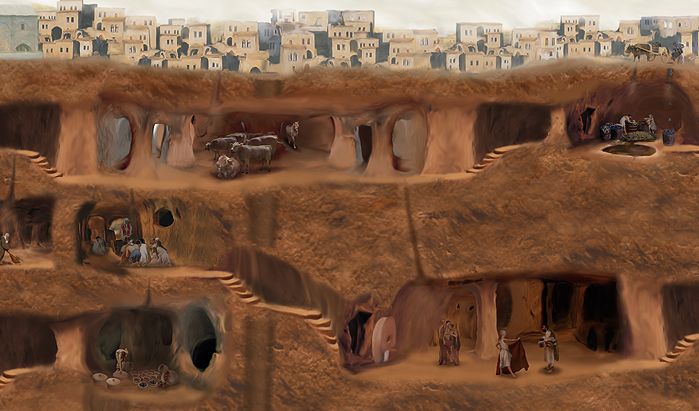
We visited Derinkuyu, an underground city in Cappadocia where early Christians lived in 15-20 day increments when they needed to hide from the Romans. It's about 8 levels and was apparently built for people that were four feet tall and had no fear of claustrophobia. The construction ability of such an early civilization was incredible, with huge stone doors that rolled into place to lock out the Romans, countless ventilation shafts, churches, stables (and don't forget wine cellars) so an estimated 20,000 people could carry on with their lives as if Roman armies weren't right above them trying their hardest to break in. Didn't get the best pictures because of the lighting down there, so I pulled some from the internet.


Mock-up of the city I found that gives a better overall impression of the city. There were plenty of tunnels leading from the normal, above ground city into the secret hideaway. 


We also visited Imagination Valley, which is full of some fairy chimney's that formed into much different shapes than usual. People come here to try and pick out the shapes of animals/figures/etc. in the chimneys.

                                                                  (See the Camel?) 

I just remembered we also visited an Ancient Greek city carved into a hill, but at this point I've given up on trying to remember exactly what day this happened so its description will just live here. It was abandoned in the 1920's when its residents were sent back to Greece during the Greek/Turkish Population exchange. 


The main feature of this mountain retreat was a huge church carved into the rock by St. John the Baptist!


We also visited an outdoor museum that was home to the world's second oldest Christian Monastery, built in the 6th century. (the oldest monastery was down the street, but I think it was closed for renovations so we couldn't visit). 


(We weren't allowed to take pictures in the monastery itself, so these are just pictures of some of the other buildings and churches from the museum.)

I think that's just about all of the main highlights for this trip. I'll leave you with some pictures from our hikes around Cappadocia.


A tree full of "Evil Eyes", dark blue disks with a white and blue eye in the center. Turks hang evil eyes everywhere: outside their houses, their stores, from their rear-view mirrors and key-chains and basically anything/anywhere else you could think of. The blue eye represents Medusa's eye, and you hang it in various places to ward off evil and bring good luck.They date back to Byzantium times when Romans used them as talismans to keep the evil away.  I will be picking one of these up to bring home with me for sure!

Monday, July 14, 2014

Living History: Urfa, Mardin, and Southeast Turkey

This will be my longest post yet. We spent four non-stop days touring the Southeast of Turkey, which is significant for its large Kurdish population and for its proximity to Syria. We flew into Urfa on Friday afternoon, met our driver and guide for the day, and immediately drove to Göbekli Tepe. Göbekli Tepe was only discovered in 1996 but is over 11,600 years old (thousands of years older than Stonehenge!), which makes it the world’s oldest known temple. It’s made up of multiple circular groupings of limestone pillars that have animal and human figures carved into them.


I didn’t get the best pictures of the stones because a temporary wooden structure had just been built to protect Göbekli Tepe from the sun and elements (it was buried for thousands of years before being found in the 90’s) and probably to protect the archaeologists that are still excavating more temples from the 110+ degree heat.


Next we drove to a small nearby village to tour some of the beehive houses the area is famous for.


And also the ruins of an old Umayyad madrasah (university) which the mongols looted and burned down (this was a common theme at sites throughout the trip).


After lunch back in Urfa we drove to our hotel, dropped our bags off, and began to wander the old section of the city. We saw fish lake, were Abraham is said to have landed after being thrown off the mountain and into a fire by King Nimrod

                                                               (mountain/roman fortification)

                                                                         (fish lake)

As well as the cave where Abraham was born.


We walked around Urfa after a late dinner and came across a Ramadan festival in downtown. The city is much more crowded at night (wonder if that has anything to do with the 110+ heat and not being able to eat or drink water all day??)

                                                               ( abandoned gardens of Urfa)

Day two started with a drive along the Turkey/Syria border to Mardin, a very interesting city that is applying for UNESCO world heritage site status.  


The border is more of a neutral zone, with fences on the Turkish and Syrian side separated by a large mine field. We did not see any evidence of any conflict spillover since ISIS is mostly near the Syrian border with Iraq.  The road itself is part of the route Silk Road travelers would have taken. We saw the large man made hills constructed by travelers as landmarks so they wouldn’t get lost on this part of the journey (the desert landscape looks the same in all directions here)

                                       (Minefield in the no man's land between Syria and Turkey)

In Mardin, we met up with our new guide, Mesut Alp, who is a local archaeologist/filmmaker/community leader and all around most interesting man in Turkey. Many of the sites we visited with Mesut in the next few days were archaeological sites that he had discovered himself. His historical knowledge of the area and ruins was incredible and was made even more so by comments like, “My friends, over there in that cave I found 20 people buried with all their weapons and loot from the war between (insert historical factions here) and it is now the oldest known soldier burial complex in the world,” or something to that general effect. We visited so many ruins of such age that now for me to consider something truly “ancient” it must be at least 5,000 years old. And what’s even more amazing is that we are some of the first people to ever see these ruins.  They've only been discovered in the last few decades and most are still being excavated (mostly by Mesut). I remarked more than once that had these ruins been in Rome or Greece or an area more prone to tourist traffic, there is no way we would be climbing over and through them as we did. We would be observing them as tourists in the future most likely will, from behind ropes so as not to disturb them. We took our privilege seriously and made sure not to cause any damage to our surroundings, but being some of the first people to walk on the same streets and bridges and entering the same tombs and temples as people from thousands of years ago was unforgettable.


(Pictures of the Ancient city of Dara, built by the Romans and captured later by the Persians. Our guide Mesut is explaining the significance of the text carved into a slab of limestone. You can barely make out the earliest version of the Christian Cross on the leftmost portion of the limestone.)


(Ancient agora of Anastasiopolis. Below is the ruins of a bridge, a tower, and a cistern)


My hotel room in Mardin was easily the coolest one I’ve ever stayed in. The stone work on the ceiling was incredible, it had its own ancient cistern, and best of all Air Conditioning. (best night’s sleep since I’ve been in Turkey!)


(you can see the stairs down into the cistern in the back left of the picture)


                                   (View of the plains of Mesopotamia from our hotel balcony.)


On Sunday we visited Mesut’s hometown and a Syriac Christian church, Mor Yacob (Mor means saint). The family that lives next door and maintains the church is one of the last Syriac Christians in the area and they were nice enough to give us a tour (And of course, Mesut was doing excavation work in the gardens surrounding the church so he gave us a lot of history as well). Mesut also asked the father to speak to his son in Aramaic, the language Jesus would have spoken when alive which has all but disappeared now, so that we could hear it.


                                                               (Part of Mesut's excavations)
           (Tomb of St. Jacob, one of the attendees of the council of Nicaea, in the church's catacombs)

This was also the closest we got to the Syrian border.
                                  (“Point Zero” border crossing between Syria and Turkey.)

We had lunch at the coolest riverside restaurant. It was basically the beach for landlocked southeastern Turkey, with kids running around and splashing in the water and a swimming area (for men only) at the entrance to the park. We sat on piles of cushions on top of wooden pallets that had been built out over the river and had some of the best food of the trip so far.


After lunch we had tea with a retired member of the Turkish Grand National Assembly who also happens to be Kurdish. This was unplanned, Mesut just wondered over to us with a man in a bright bathing suit in tow and said, “My friends, this is my good friend and very important Kurdish politician that has agreed to speak with us.” It was kind of an informal question and answer session about Kurdish life and their future political goals. Very interesting.

Monday was another full day, heading first to one of two Syriac Christian monasteries we would see that day.


Stopped for lunch in Mediyat, a town known for its silver and apparently Mesopotamian wine. Bought two bottles to try, (hopefully one of them will make it back to the states!) but didn’t buy any jewelry because there was too much to look at during our short stop over there (sorry everybody). Our big group also attracted the most attention of any visit thus far (a small group of local kids attached themselves to us as soon as we got off the bus and by the time we left there must have been at least 24).

After lunch it was off to the second monastery of the day. It was the most intact, having not been completely ransacked by either the Mongols or the Persians or some other war prone empire.


                                                 (Oldest tile mosaic ceiling in Turkey)

Next was Hasankeyf, an ancient city built on the banks of the Tigris River (we also drove over the Euphrates River a few times around Urfa).


We waked down a steep hill to get our feet wet in the famous river and admire the ruins of an old roman bridge.

(You can just make out the 3 columns of the bridge in front of the mountain. Those are just the supports; the actual bridge was made of wood planks so they could be taken up if the city was attacked)


There were also some very cool dwellings carved into the side of the mountains all around Hasankeyf.
The sad part is that most of what you see in these picture will be underwater in a year. The Turkish government has been working on a dam nearby and when it’s completed the water level in Hasankeyf will be so high that everything in the pictures that’s under the top of the minaret will be submerged. So we were some of the first people to see the ancient ruins and temples of Göbekli Tepe in thousands of years, and we are some of the last people to see the ruins of Hasankeyf for potentially thousands of years, if it ever resurfaces.

After skipping some stones on the Tigris, we drove to Batman (yes, you read that right) to have dinner and fly back to Istanbul. The signs we saw in this city were pretty great: “Batman University,” “Batman Airport,” and even a “Batman Land”


It was a late flight back to the airport on the Asian side of Istanbul, and an even longer bus ride from there back to campus. We saw so much it was impossible for me to include everything here, but I won’t be forgetting this trip any time soon.