First stop after the 8 hour early morning bus ride to Ankara was the Turkish Parliament. We went through more levels of security than two of your average American airports combined. As a general rule, the security in all government buildings we visited was unusually high and sometimes even completely useless. Case in point, our visit to Atatürk's mausoleum, where we were told to get off our bus, leave all our belongings behind, go through a security checkpoint, get back onto our bus (which hadn't been searched) and drive into the mausoleum complex. (Can you spot the hole in this process? No? Neither can they...) But more on that later.
Back to Parliament! It was in session when we visited, so we didn't get to visit the actual chambers where the members meet. But we did get a tour of the other main parts.

(Atatürk's watchful face looking down on an ornate door in the main lobby of Parliament)

(Copies of the original founding documents of the Turkish Republic (early 1920's). Think US Constitution.)
The parliament building itself wasn't that impressive, but thankfully we had a productive meeting with a Parliament Minister from the Kurdish party, HDP. Election season (which in Turkey is only about a month and a half or so!) is in full swing, so we got an interesting take on the candidates from the Kurdish MP and a general overview of his party's platform. (We're here during both Ramadan and Turkey's first ever direct Presidential election. There are also increased tensions in Turkey's neighbors Syria (thanks to ISIS and it's new caliphate) and Israel (renewed fighting in the Gaza Strip). We wanted a cultural experience that was different from anywhere we'd been before, and we're getting it.)
While in Ankara, we also visited: the Turkish Ministry of Foreign Affairs to meet with the director of a Strategic Foreign Policy Research Center; Ipek University, a brand new university which has a campus that is still under construction (although the administration and professors that we visited there prefer the term city, and after seeing the model of the completed campus I won't argue with them); and the Headquarters of the AKP, the ruling party of Turkey for the last 12 years. All the visits were pretty interesting in their own way (remember, we're PoliSci and Intl Affairs students), but the AKP was the only visit that got a little...uncomfortable. There have been a lot of recent corruption allegations against the government and our horde isn't shy about asking tough questions. It got a bit heated in the beginning while talking with a very defensive, high level staffer, but cooled down some after the arrival of the AKP's Vice President, who was much more level headed and also talked so much we didn't really get a chance to ask more questions.
As I mentioned earleir, we visited Atatürk's mausoleum on the way out of town Friday. Atatürk was the Turkish General that led the fight for Independence against the European countries that occupied the former territory of the Ottoman Empire after WWI. After the war, he founded the secular Turkish Republic and tried his best to set Turkey on the fast track to Westernization. Almost a hundred years later, his face is EVERYWHERE in Turkey, and he's still revered by the people. The grounds, mausoleum, and underground museum are very Impressive, although the museum is extremely (I mean very!) nationalistic.


(Cool boat used to ferry Atatürk around)

(Changing of the guard at Atatürk's tomb)
And now for the fun part! We got back on the bus for a few hours drive to Cappadocia. On the way we stopped at Turkey's Great Salt Lake, which is actually a lake from late fall until late spring. But during the summer months, all the water evaporates, leaving behind a huge salt flat, home to endless mirages and enough salt to keep Mortons in business for years.

(The flats actually reminded me a lot of the beaches at home!)
Cappadocia is a region in Turkey famous for it's otherworldly landscape. The area is home to a couple dormant volcanoes. A long time ago (can't remember the exact timeline, too much history here!) they erupted and formed a crazy looking landscape unlike anything I've ever seen anywhere else, in person or in pictures. The volcanic rock was so soft, the people that lived here thousands of years ago carved their houses, churches, businesses, etc. into the rock itself. The softer rock was protected from erosion (at least from the top down) by a layer of harder basalt rock that formed on top, so a good portion of these rock dwellings are still standing today.

The formations are called "Fairy Chimneys" in English

We woke up early one morning for a Hot Air Balloon ride over Cappadocia. Those of us that went had to be on the bus to the launching zone at 4AM so we could be in the air for the sunrise, which sounds doable in theory but in practice is almost impossible after a full day of hiking and 3 hours of sleep. But it was definitely worth the agony and sleeplessness. Seeing hundreds of other balloons rise into the air while the sun rose over the alien landscape was one of the most incredible experiences I've ever had (I know I've already said that a couple times on this blog, but there are so many incredible things to do here!) I probably took over 300 pictures during the hour and a half flight, so picking a handful to attach to this post was a challenge!


The balloon's crew even had champagne waiting for us when we landed in the middle of a local vineyard (supposedly to celebrate our successful landing, although I hope a safe return isn't so uncommon as to be champagne worthy. Either way, you didn't find any complaints over the bubbly among our group.)

We also went to the studio of a local Ceramics master, who learned his trade from his father and spent 18 years (I believe) studying all aspects of pottery before earning his tittle. He made a flawless teapot in about 20 mins while carrying on a conversation and drinking local wine with us.

He also looked a lot like Einstein.
I bought a few gifts from his huge studio, although I bought pieces made by his apprentices, nothing made by the master himself (there's no way my college budget could afford those prices!). Later that day we went to the shop of a family of Turkish rug enthusiasts and learned more than we ever wanted to know about the different types of rugs and how're they're made. They weren't concerned so much with selling us their rugs as they were about educating us about what to look for/avoid when buying rugs around Turkey (they even seemed a little sad to part with some of their rugs when a few of us bought some smalls ones to bring home).
We visited Derinkuyu, an underground city in Cappadocia where early Christians lived in 15-20 day increments when they needed to hide from the Romans. It's about 8 levels and was apparently built for people that were four feet tall and had no fear of claustrophobia. The construction ability of such an early civilization was incredible, with huge stone doors that rolled into place to lock out the Romans, countless ventilation shafts, churches, stables (and don't forget wine cellars) so an estimated 20,000 people could carry on with their lives as if Roman armies weren't right above them trying their hardest to break in. Didn't get the best pictures because of the lighting down there, so I pulled some from the internet.

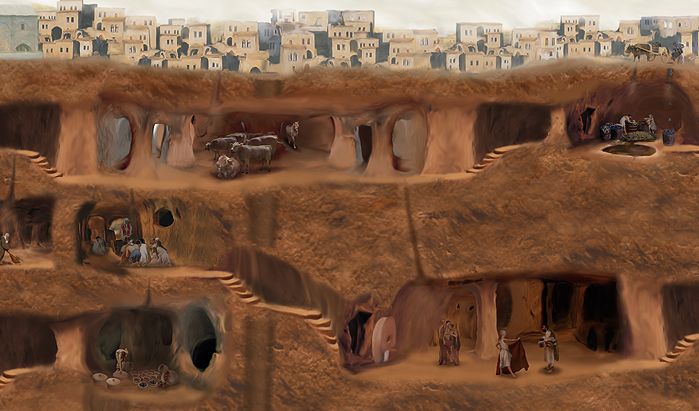
Mock-up of the city I found that gives a better overall impression of the city. There were plenty of tunnels leading from the normal, above ground city into the secret hideaway.
We also visited Imagination Valley, which is full of some fairy chimney's that formed into much different shapes than usual. People come here to try and pick out the shapes of animals/figures/etc. in the chimneys.

(See the Camel?)
I just remembered we also visited an Ancient Greek city carved into a hill, but at this point I've given up on trying to remember exactly what day this happened so its description will just live here. It was abandoned in the 1920's when its residents were sent back to Greece during the Greek/Turkish Population exchange.

The main feature of this mountain retreat was a huge church carved into the rock by St. John the Baptist!

We also visited an outdoor museum that was home to the world's second oldest Christian Monastery, built in the 6th century. (the oldest monastery was down the street, but I think it was closed for renovations so we couldn't visit).


(We weren't allowed to take pictures in the monastery itself, so these are just pictures of some of the other buildings and churches from the museum.)
I think that's just about all of the main highlights for this trip. I'll leave you with some pictures from our hikes around Cappadocia.


A tree full of "Evil Eyes", dark blue disks with a white and blue eye in the center. Turks hang evil eyes everywhere: outside their houses, their stores, from their rear-view mirrors and key-chains and basically anything/anywhere else you could think of. The blue eye represents Medusa's eye, and you hang it in various places to ward off evil and bring good luck.They date back to Byzantium times when Romans used them as talismans to keep the evil away. I will be picking one of these up to bring home with me for sure!

Absolutely remarkable images. Thanks Dustin!
ReplyDeleteBeautiful pictures accompanied by descriptive dialogue...it's like I can almost see it! So happy that you are getting to add these adventures to your life story. Safe travels Dustin!
ReplyDelete